High-quality dosing technology for use in industry and commercial applications.
Specialists for your water treatment systems
Our engineers will advise you comprehensively
Industrial dosing systems

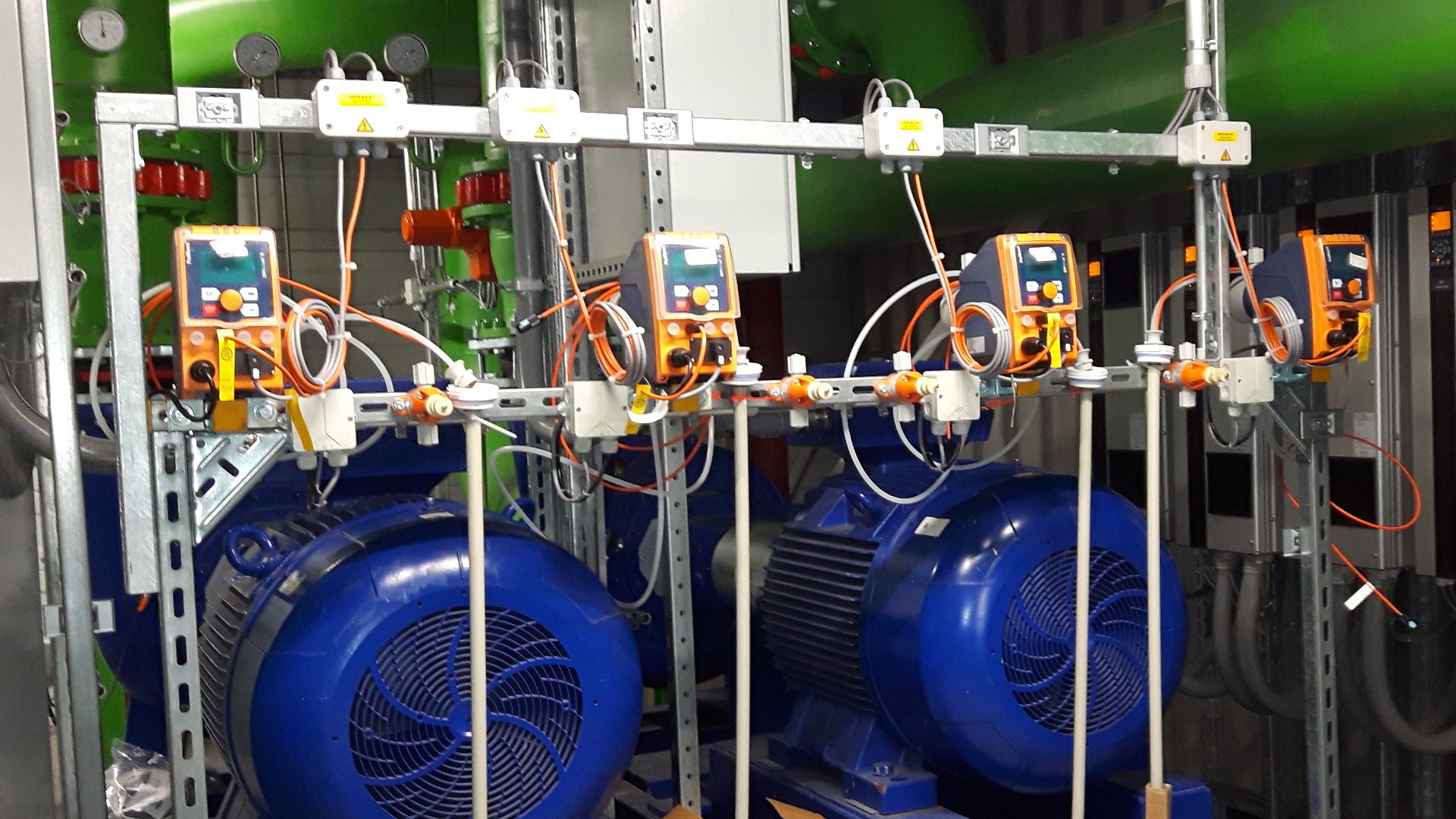
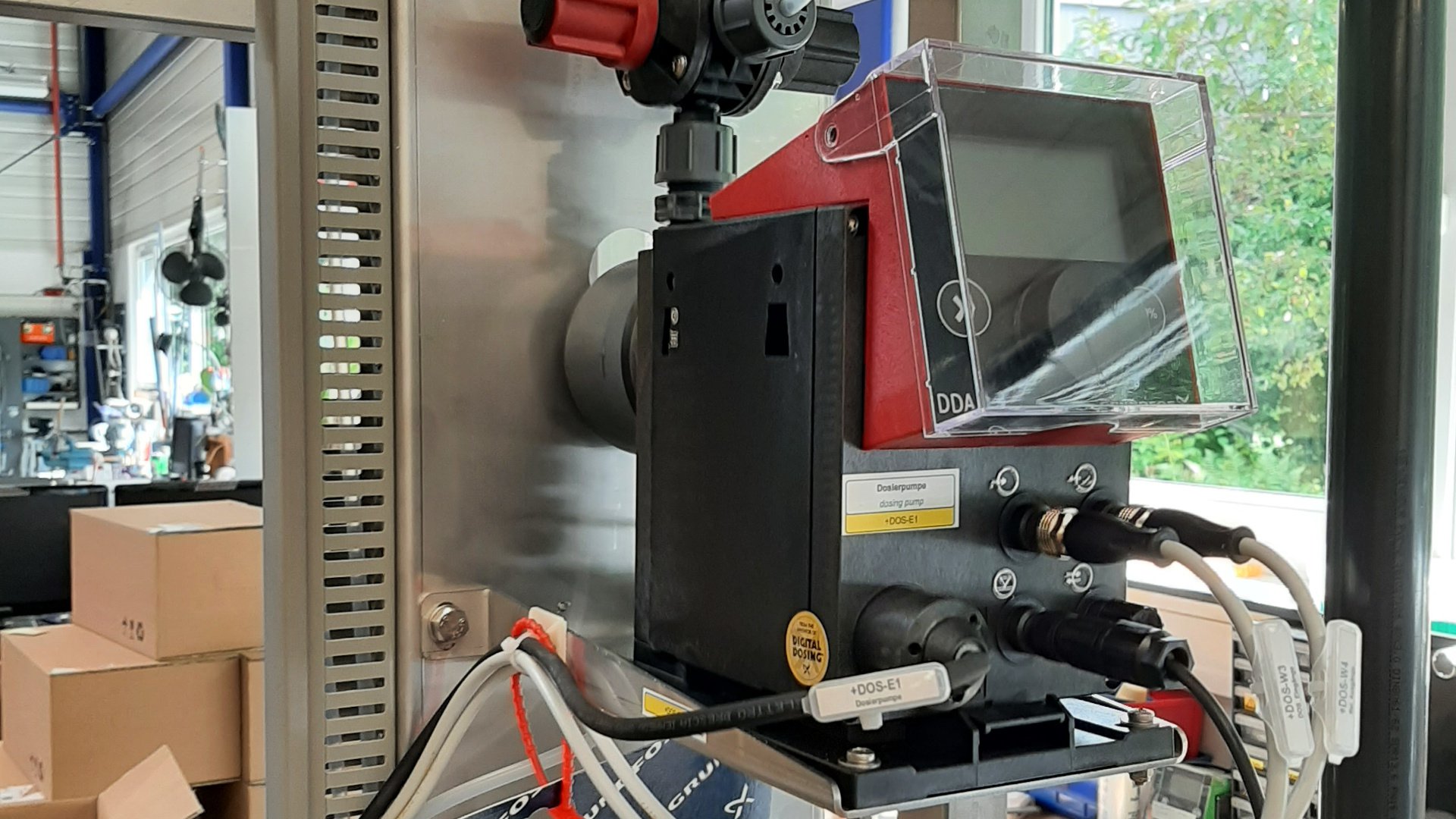
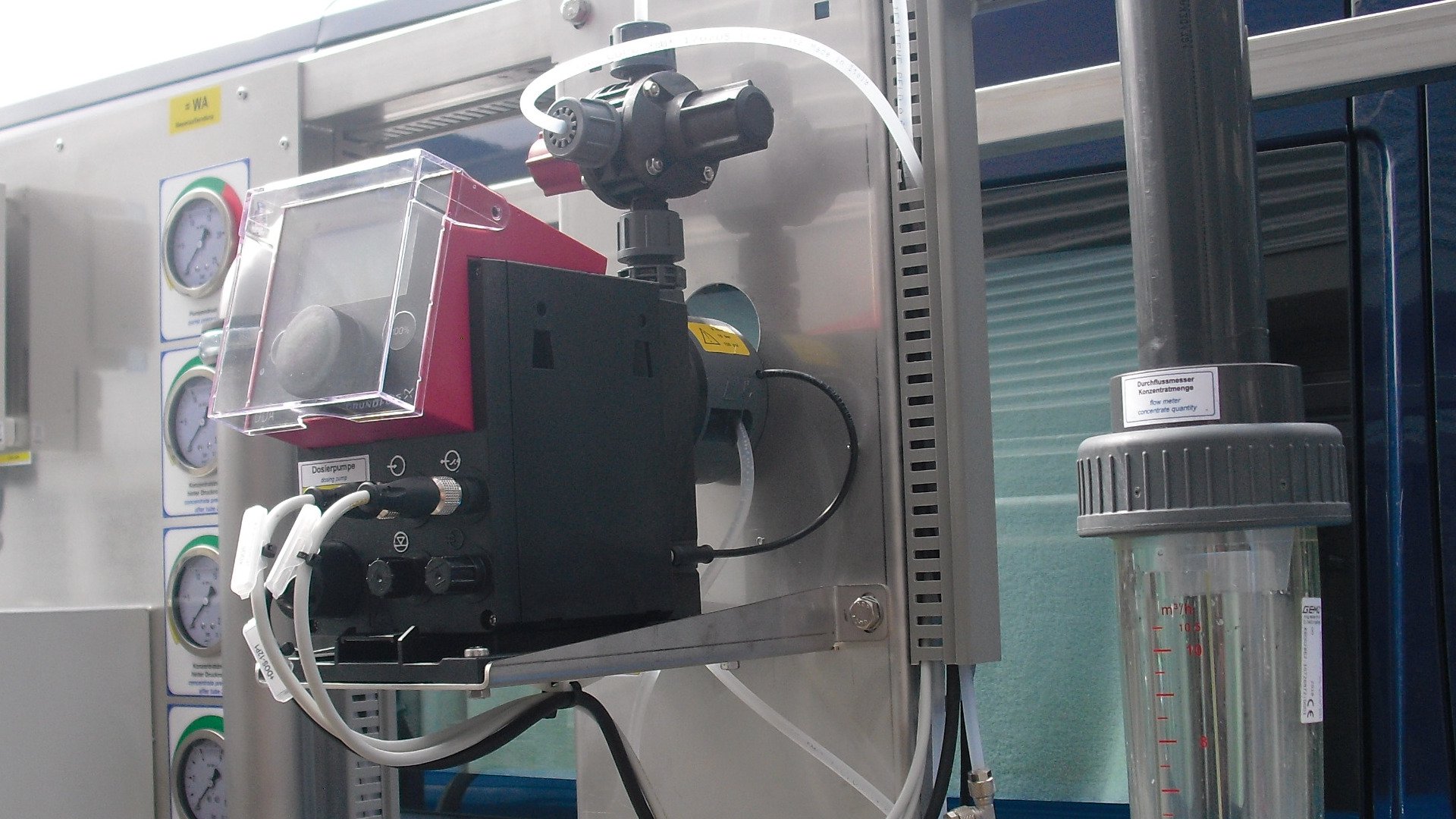
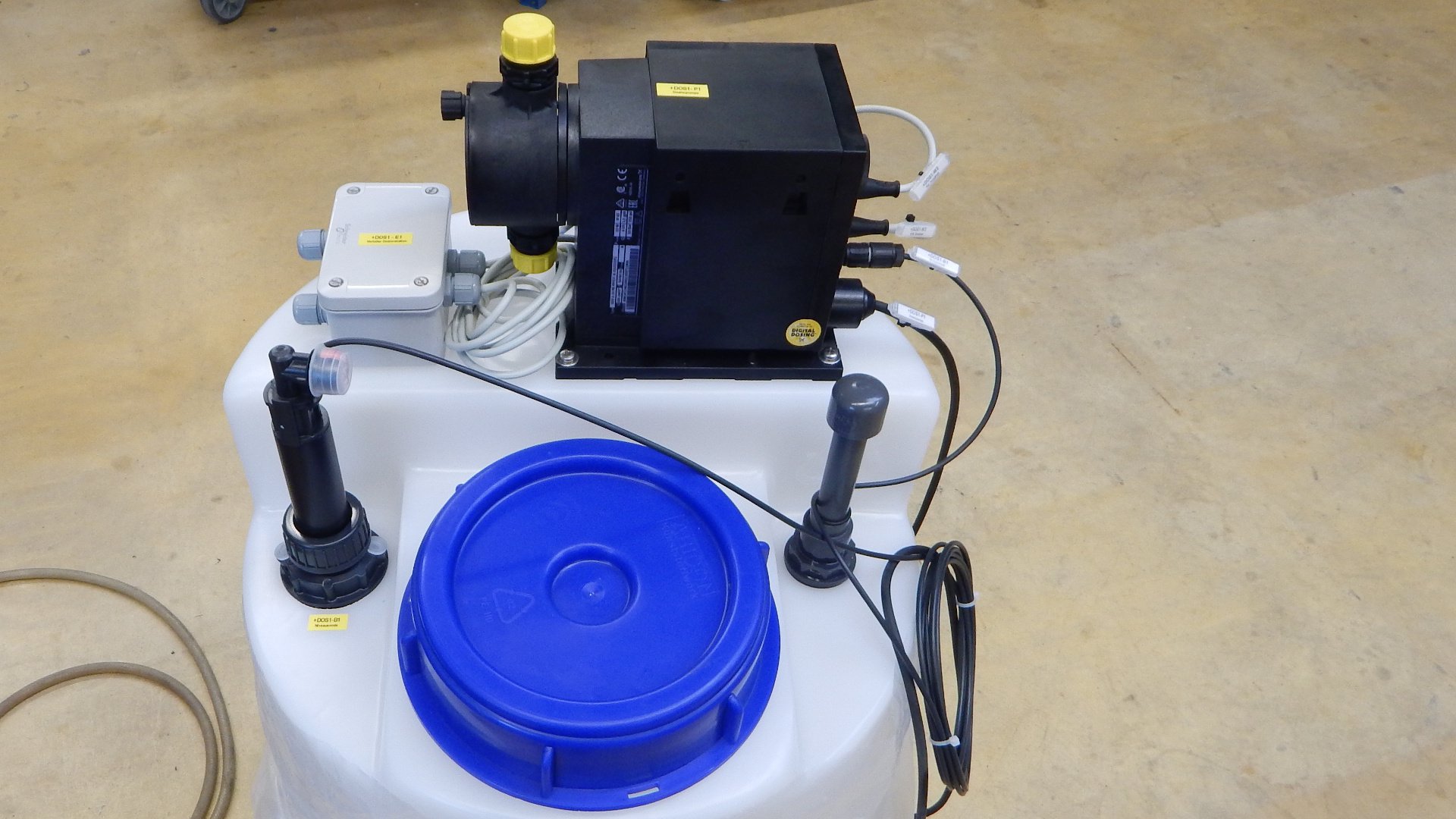
Dosing systems are used in water treatment when the properties of water are to be specifically changed by adding chemical components. These chemical components are contained in the so-called dosing solutions. These are usually aqueous solutions with low viscosity, which are then added to the medium to be conditioned (usually water) using dosing pumps.
These dosing solutions are added using special dosing pumps, usually diaphragm dosing pumps. These pumps are able to draw in the dosing solutions from unpressurised disposable or reusable containers, compress them and then dose them into the pressurised line of the medium. For most applications, a dosing capacity of a few millilitres/hour up to approx. 10 litres/hour is sufficient. The back pressure in the medium lines is usually between 4 and 16 bar.
Operating modes
Depending on the application, the dosing solution is added in proportion to quantity, continuously, in batch mode or as a function of other control variables (e.g. depending on the pH value).
With volume-proportional dosing, the volume flow of the medium is determined by means of a contact water meter or a flow sensor and transmitted to the control electronics of the dosing pump. This converts the measured value into the required dosing quantity and sends the necessary information to the pump motor.
In continuous (permanent) dosing, the dosing pump is operated in on/off mode.
In batch mode, the dosing pump delivers a quantity of the dosing chemical previously set on the control unit after release and stops when this quantity has been processed.
Depending on the design of the dosing pump, it can also be controlled via an external signal or an external controller, e.g. to set a specific pH value in the medium to be dosed.
Design of diaphragm dosing pumps
In most cases, diaphragm dosing pumps are used. These have a pump head with the diaphragm and an inlet valve (suction valve) and an outlet valve (discharge valve). The valves are equipped with non-return valves to prevent the dosing agent from being pushed back or flowing back into the feed container. When moving in one direction, the diaphragms perform a suction stroke; when moving in the other direction, they perform a dosing stroke. During the suction stroke, a vacuum is created in the diaphragm chamber, via which the dosing agent is sucked into the diaphragm chamber. During the subsequent pressure stroke, the dosing agent is pressed out of the diaphragm chamber into the pressure line.
The linear movement of the diaphragm required to perform the suction stroke and the pressure stroke is generated by an electrically operated magnetic piston or a stepper motor. In solenoid metering pumps, the solenoid piston always performs a full suction stroke or a full pressure stroke. The volume in the diaphragm chamber is limited by the adjustable stroke length.
In pumps with stepper motors, the stepper motor first performs a full suction stroke, during which the diaphragm chamber is completely filled. The diaphragm is then moved in the other direction via a gearbox with a very fine transmission ratio. The dosing agent is continuously delivered to the medium to be dosed.
This pump technology has two significant advantages over magnetic piston technology:
- Even the smallest dosing quantities can be added quasi-continuously.
- The fact that a full suction stroke is always carried out over the entire chamber volume ensures reliable suction even with low dosing quantities.
Dosing pumps/dosing systems
Dosing systems can be used as stand-alone solutions with a single dosing pump or as a dosing system with one or more pumps, containers, additional fittings and higher-level controls.
Additional fittings are also required in stand-alone operation to ensure the safe and precise addition of the dosing chemical:
- Suction set:
The dosing solution is sucked out of the unpressurised container via this. It is equipped with a foot valve that prevents the dosing agent from flowing back into the container and thus contributes to its safe suction.
Furthermore, the suction set usually has two level switches (pre-alarm and dry-running) to remind the operator to refill in good time or to protect the pump from running dry. - Pressure maintenance valve (multifunction valve)
This ensures a constant pressure on the pressure side of the pump, regardless of pressure fluctuations in the line of the medium to be dosed, thus contributing to increased dosing accuracy. - Injection point
The dosing medium enters the medium line via this. An additional non-return valve prevents the medium from flowing back into the dosing line. Injection points can also be equipped with a shut-off valve, which allows the injection point to be removed without having to empty the medium line. - Dosing containers and dosing containers
- In many cases, the dosing agent is added from disposable containers or, for larger quantities, from 200 litre drums or cubitainers. The empty container is replaced with a new container.
Dosing containers are used in particular when dosing agents are to be prepared on site. These can also be equipped with agitators. Dosing containers must be emptied and cleaned at regular intervals.
At W.A.L. Wassertechnik you get everything from a single source.
In addition to our standard series, we also produce customised dosing systems including comprehensive sensor technology. On request, we can install the dosing system directly on your premises. We commission the system together with you. We maintain and repair your dosing systems at regular intervals.
Our highly qualified service technicians carry out all work professionally and in the required time. Contact us, we will be happy to help you.
Antiscalant dosing station
Water that is to be desalinated using reverse osmosis systems and devices must always be pretreated in such a way that the solubility product of the substances it contains is not exceeded. Exceeding this limit will inevitably lead to precipitation and damage to the highly sensitive membranes of the reverse osmosis system. For this reason, the water is either softened via cation exchange or, particularly in the case of high water hardness, treated with an antiscalant to prevent precipitation.
As only homeopathic dosing quantities are required, high demands are placed on the quality and accuracy of the dosing technology. Use the tried and tested antiscalant dosing stations from W.A.L. Wassertechnik GmbH for the professional pre-treatment of your raw water. Thanks to continuous dosing, they ensure the exact addition of even the smallest quantities. With the DDA series, malfunctions such as leaks, air bubbles in the suction or pressure line or excessive back pressure are recognised fully automatically and trigger a fault message. In this way, faults are recognised in good time and expensive consequential damage is avoided.
Contact us
Please fill out the form to contact us. Summary of your message: