Here you will find information on the treatment (softening/descaling) of drinking water using single softening systems.
Process engineering
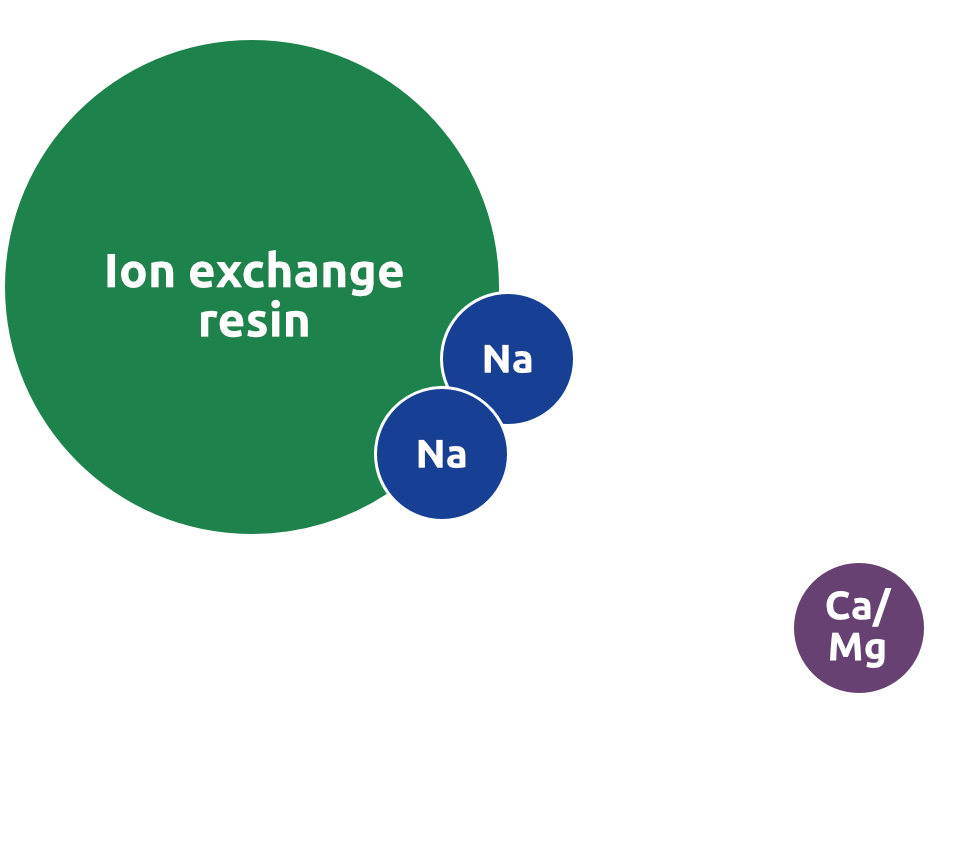
Our individual water softeners work according to the ion exchange principle. The water to be softened is passed through an ion exchanger material, which removes the hardness components calcium and magnesium and replaces them with the equivalent amount of sodium ions.
Once the capacity of the ion exchanger is exhausted, it must be regenerated. To do this, highly diluted brine is passed over the exchanger material instead of water. Due to the excess of sodium ions in the brine, the process described above is reversed: the exchanger accumulates sodium ions and releases the retained calcium and magnesium ions. These are flushed out together with the rinsing water as waste water.
All materials that come into contact with the water are food-safe. The effectiveness of the softening process can be verified with easy-to-use test kits. If it is absolutely necessary to prevent the release of hard water when passing over the softening system, the water quality of the soft water can also be monitored fully automatically using appropriate devices (see accessories).
Areas of application
Our singlewater softeners are used to soften iron- and manganese-free water to drinking water quality.
Depending on the application, semi-automatic or fully automatic systems can be considered. Depending on the raw water quality and the operating conditions, the fully automatic systems are equipped with either time-controlled, computer-controlled or water meter-controlled regeneration activation.
The singlesoftening systems are used wherever water without disruptive hardness is required as drinking or process water, e.g:
- in small, medium-sized or large industrial and commercial enterprises
- in public buildings, hospitals, administrative and service buildings
- in hotels and catering establishments
- in private households
Control types
Semi-automatic
A low-cost version that has its advantages with irregular soft water consumption; regeneration is triggered manually as soon as a hardness breakthrough is detected when checking the soft water quality. The regeneration cycles themselves are carried out automatically
Time-controlled
with constant soft water consumption; regeneration is triggered and carried out fully automatically at pre-set daily intervals.
water meter controlled
Regeneration only takes place after the previously programmed total capacity of the water softener has been exhausted. The soft water consumption is continuously measured via a contact water meter and transmitted to the control system to calculate the remaining capacity.
Specification
The systems essentially consist of the following assemblies:
- Filter container made of glass fibre-reinforced plastic with a filling made of high-quality
- Cation exchange material in food quality
- Three- or five-stage control valve made of plastic or gunmetal
- Salt dissolving tank or space-saving cabinet tank, some with sieve bottom and brine valves
- Contact water meter (for water meter-controlled systems)
- Semi-automatic or fully automatic control
- and various assembly materials.
The systems are pre-assembled and electrically wired ready for connection at the factory. The filter containers of smaller systems are already filled with the replacement material at the factory. Larger systems are filled on site during installation. For reasons of operational safety, the fully automatic systems are supplied with 24V/50Hz low voltage via a plug-in transformer as standard. Other voltages are available on request.
Montage
The water softener is either installed centrally downstream of the water meter of the municipal utility company and the fine filter or directly upstream of the consumer or the hot water supply in the hard water pipe. During installation, DIN EN 806, DIN EN 1717 and DIN 1988 as well as local regulations must be observed. In particular, a pipe separator or system separator must be installed upstream of the system. To save time when connecting, the use of an installation block is recommended for some system types. The connection between the system and the installation block is then established using flexible pressure hoses.
If the system is installed centrally, it must be ensured that any hard water outlets for consumers that are to be supplied with hard water are installed upstream of the system.
If the soft water is to be blended with hard water, an additional blending valve is required for various systems (see also "Performance overview" table).
If the discharge of hard water for the duration of regeneration is undesirable, a solenoid valve must be installed in the soft water line downstream of the system. This valve can be activated directly during regeneration in various series.
Functional sequence
After filtration via a fine filter, which we strongly recommend installing upstream of the system, the hard water is channelled into the filter tank via the control valve and softened as described in the "Procedure" section. The soft water leaves the system via a separate outlet on the control valve.
When the capacity is exhausted, the exchanger filling must be regenerated. Regeneration is triggered either semi-automatically or fully automatically, depending on the control system used. The regeneration itself is fully automatic for all system types. During the regeneration process, hard water is released into the soft water pipe via a bypass valve built into the control valve so that the water supply to the consumer is ensured.
Once the individual regeneration phases have been completed, the system is back at full capacity and returns to the operating position fully automatically.
The water required for the next regeneration to prepare the brine is also returned to the salt dissolving tank fully automatically. Only the regeneration salt supply needs to be checked and replenished at regular intervals.
Raw water quality
Requirements for raw water quality
The water softeners may only be operated with pre-filtered, cold water of drinking water quality in accordance with the German Drinking Water Ordinance TrinkwV2001.
The suitability of other water must be checked by analysing the water. The following minimum limit values must always be observed:
| Temeperatur | 1 - 30°C (33,8 - 86°F) |
| Pressure (flow pressure) | 2,5 - 7,0 bar (36 - 102 psi) |
| Max. operating pressure | 7,0 bar (102 psi) |
| pH value during continuous operation | 6 - 8 |
| Free chlorine | < 0,1 mg/l (< 0,1 ppm) |
| Turbidity index max. | 1 NTU |
| Iron content | < 0,1 mg/l (< 0,1 ppm) |
| Manganese content | < 0,05 mg/l (< 0,05 ppm) |
If one or more of the values listed above are exceeded, suitable additional pre-treatment measures must be taken.