- 90 – 180 l/h


Usage
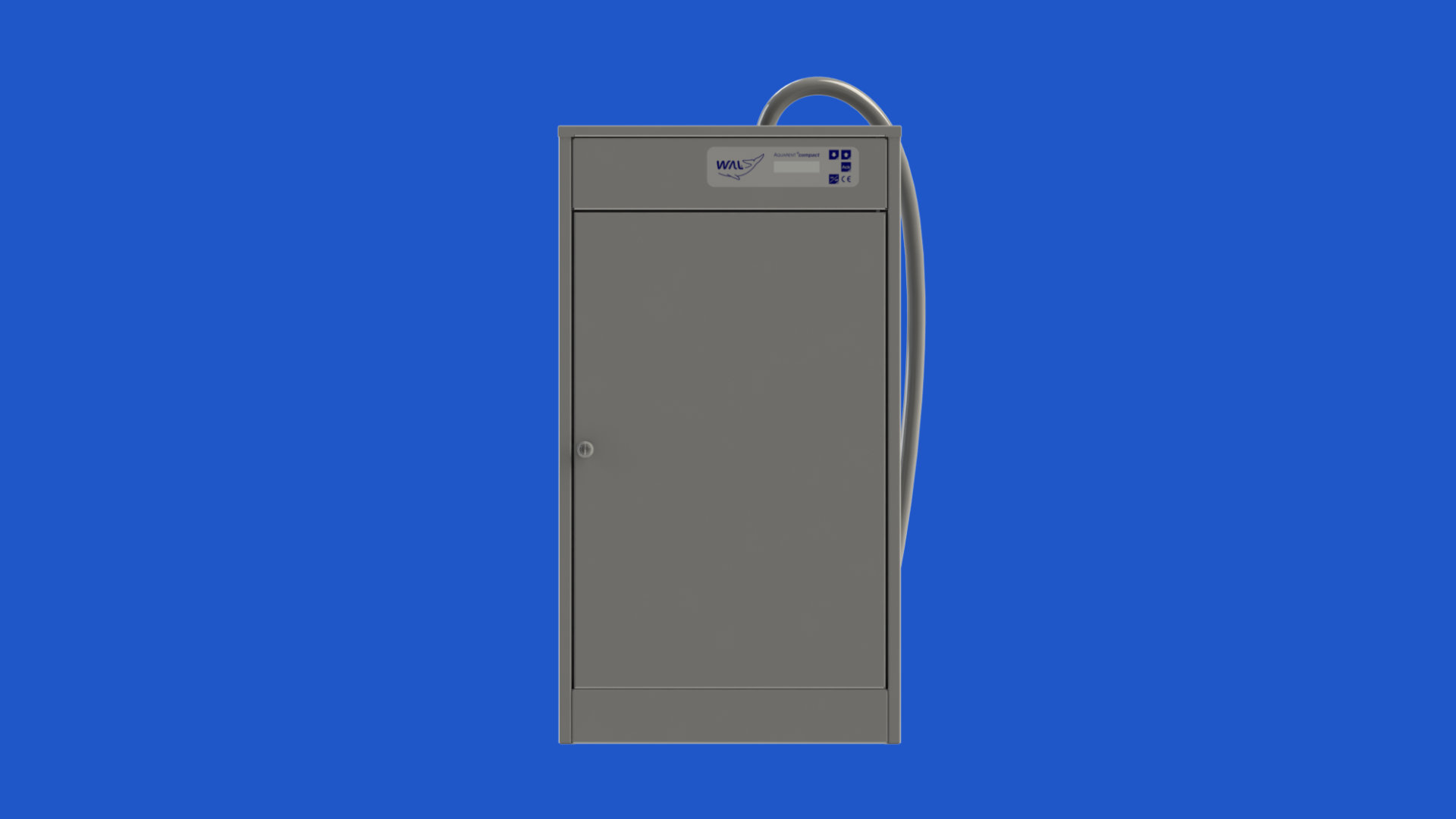
The reverse osmosis units in the AQUArent® C series are fully sensor-controlled, reliable, durable, and user-friendly devices for desalinating drinking water.
The units are designed to supply consumers who generally require small amounts of desalinated water at regular intervals. With the appropriate additional equipment, the units can also be used to supply consumers with different consumption patterns.
A fully enclosed stainless steel housing and a quiet stainless steel centrifugal pump enable use in visually demanding and noise-sensitive areas. The intelligent control system monitors all operating states and communicates with the plant operator via a 2-line display.
Functionality
The desalination process in reverse osmosis systems is based on a membrane diffusion process in which pure water passes through a semi-permeable membrane under high pressure and salts, colloids, and other substances are retained by the membrane. The water fed into the reverse osmosis system is divided into a pure water volume flow (permeate) and a waste water volume flow (concentrate). The proportion of the concentrate flow fed to the wastewater must not fall below a certain minimum, as this can lead to deposits (scaling or fouling) on the membrane surface and a associated drop in system performance. To improve efficiency and increase cost-effectiveness, the other portion of the concentrate flow is returned to the pump and passed through the membrane again together with the fresh water flow. The built-in pressurized buffer tank stores up to 10 liters of permeate and is used to cover consumption peaks.
An integrated pretreatment system using an antiscalant dosing pump protects the membranes from deposits. Pressure and flow sensors monitor all relevant parameters. The sensor data is interpreted by the microcontroller control system developed in-house and output as plain text operating messages on the display. A fully automatic raw water emergency feed ensures the supply to the connected consumer in the event of a malfunction (e.g., power failure).
Advantages
Environmentally friendly process
Monitoring and documentation of operating parameters
Error history with timestamp
Continuous permeate production
Security of supply through fully automatic emergency feed
Fully automated operation
Low operating and maintenance costs
Space-saving design
Low operating costs
Scope of delivery
Ready-to-connect, pre-assembled AQUArent® C reverse osmosis unit, consisting of:
Stainless steel housing closed on all sides with adjustable feet, removable side panels, and removable lid (lockable), with front door for service purposes (lockable)
Integrated raw water conditioning consisting of an antiscalant dosing pump with a 5-liter antiscalant tank with suction lance and level control, sufficient for producing approx. 75,000 liters of permeate.
Fine filter assembly
Low-noise pressure booster pump as stainless steel centrifugal pump
Low-pressure high-performance module(s)
Pressure sensors for inlet pressure and clean water tank pressure
Volume flow sensors for inlet and clean water volume flows
Inlet and flush solenoid valve
Conductivity sensor
Temperature sensor
Blending valve for blending permeate
Internal leakage monitoring system
Internal storage vessel as diaphragm expansion tank (useful capacity approx. 10 l)
FlowControl system for low-maintenance regulation of the UO process
Integrated, fully automatic emergency feed with electrically open solenoid valve
Microcontroller control